
Polynomial representation and addition using Linked List
A polynomial p(x) is the expression in variable x which is in the form (axn + bxn-1 + …. + jx+ k), where a, b, c …., k fall in the category of real numbers and 'n' is non negative integer, which is called the degree of polynomial.
An essential characteristic of the polynomial is that each term in the polynomial expression consists of two parts:
- Coefficient
- Exponent
Example :
10x2 + 26x, here 10 and 26 are coefficients and 2, 1 is its exponential value.
Points to keep in Mind while working with Polynomials :
- The sign of each coefficient and exponent is stored within the coefficient and the exponent itself.
- Additional terms having equal exponent is possible one.
- The storage allocation for each term in the polynomial must be done in ascending and descending order of their exponent.
Representation of polynomial :
Polynomial can be represented in the various ways. These are:
- Using array
- Using linked list
Polynomial using linked list:
We store each polynomial as a singly linked list where each node stores the exponent and coefficient in the data part and a reference to the next node as shown in the figure below. Their sum is then stored in another linked list
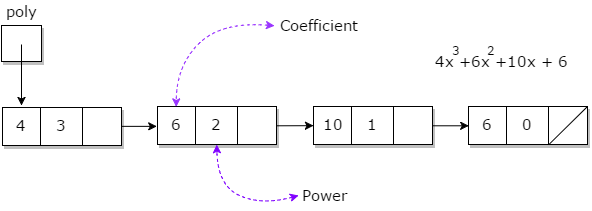
Procedure :
We store each polynomial as a singly linked list where each node stores the exponent and coefficient in the data part and a reference to the next node as shown in the figure below. Their sum is then stored in another linked list
Algorithm
Step 1: Start.
Step 2: Define user defined datatype node consisting of int coefficient and exponent and a pointer next of type node.
Step 3: Defining create function
	struct node* create(struct node* head, int co, int exp)
		Check if(head == Null)
			temp <- GetNode(node)
			temp.co <- co
			temp.exp <- exp
			temp.next <- Null
			Set head <- temp
		otherwise
			Set temp <- head
			while(temp.next ≠ Null) do
				temp <- temp.next
			flag <- GetNode(node)
			flag.co <- co
			flag.exp <- exp
			flag.next <- Null
			temp.next <- flag
	         return head

Step 4: Defining Addition function
	struct node* polyAdd(struct node *p1, struct node *p2, struct node *sum)
		Set poly1 <- p1
		Set poly2 <- p2
		Set result <- Null
		check if(poly1 ≠ Null AND poly2 == Null)
			Set sum <- poly1
			Return sum
		else if(poly1 == Null AND poly2 ≠ Null)
			Set sum <- poly2
			Return sum
		while(poly1 ≠ Null AND poly2 ≠ Null) do
			Check if(sum == Null)
				sum <- GetNode(node)
				Set result  <- sum
			Otherwise
				result.next <- GetNode(node)
				Set result <- result.next
			Check if(poly1.exp > poly2.exp)
				Set result.co <- poly1.co
				Set result.exp <- poly1.exp
				Set poly1 <- poly1.next
			Check if(poly1.exp < poly2.exp)
				Set result.co <- poly2.co
				Set result.exp <- poly2.exp
				Set poly2 <- poly2.next
			Otherwise
				Set result.co <- poly1.co + poly2.co
				Set result.exp  <- poly1.exp
				Set poly1  <- poly1.next
				Set poly2  <- poly2.next
		while(poly1 ≠ Null) do
			Set result.next  <- GetNode(node)
			Set result <- result.next
			Set result.co <- poly1.co
			Set result.exp <- poly1.exp
			Set poly1 <- poly1.next
		while(poly2 ≠ Null) do
			Set result.next <- GetNode(node)
			Set result  <- result.next
			Set result.co <- poly2.co
			Set result.exp <- poly2.exp
			Set poly2 <- poly2.next
		Set result.next <- Null
		Return sum

Step 5: Defining Display function
	void display(struct node* head)
		Set temp <- head
		while(temp ≠ Null) do
			Display temp.co, temp.exp
			Set temp <- temp.next

Step 6: Defining Main function
	Set p1 <- Null
	Set p2 <- Null
	Set sum <- Null
	Set flag <- 1
	while(flag == 1) do
		Display “1: Create Polynomial 1”
		Display “2: Create Polynomial 2”
		Display “3: Perform Addition”
		Display “4: Exit”
		Read choice
		switch(choice)
			Case 1:
				Display “Enter coefficient for polynomial 1”
				Read co
				Display “Enter exponent for polynomial 1”
				Read exp
				Call create(p1, co, exp)
			Case 2:
				Display “Enter coefficient for polynomial 2”
				Read co
				Display “Enter exponent for polynomial 2”
				Read exp
				Call create(p2, co, exp)
			Case 3:
				Set sum <- call polyAdd(p1, p2, sum)
				Call display(sum)
			Case 4:
				Set flag <- 0
		End switch

Step 7: Stop