
Menu driven stack operations
A stack is a linear data structure that follows the principle of Last In First Out (LIFO). It is a collection of items of the same type. This means the last element inserted inside the stack is removed first.
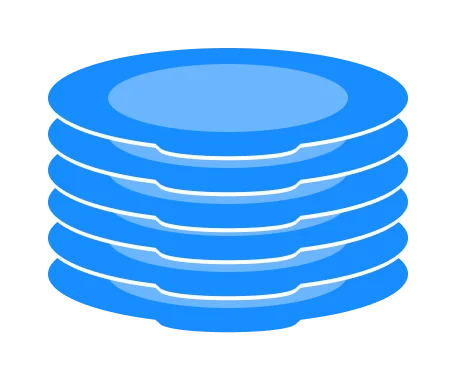
You can think of the stack data structure as the pile of plates on top of another. Here, you can:
- Put a new plate on top
- Remove the top plate
Basic Operations on Stack
There are some basic operations that allow us to perform different actions on a stack.
- Push: Add an element to the top of a stack
- Pop: Remove an element from the top of a stack
- IsEmpty: Check if the stack is empty
- IsFull: Check if the stack is full
- Peek: Get the value of the top element without removing it
And, if you want the plate at the bottom, you must first remove all the plates on top. This is exactly how the stack data structure works.
Algorithm
Working of Stack Data Structure :
The operations work as follows:
- A pointer called TOP is used to keep track of the top element in the stack.
- When initializing the stack, we set its value to -1 so that we can check if the stack is empty by comparing TOP==-1.
- On pushing an element, we increase the value of TOP and place the new element in the position pointed to by TOP.
- On popping an element, we return the element pointed to by TOP and reduce its value.
- Before pushing, we check if the stack is already full.
- Before popping, we check if the stack is already empty.